LLOYDS AFFORDABILITY REVIEW: Falling rates and rising wages ease first-time buyer challenge
27 November 2025
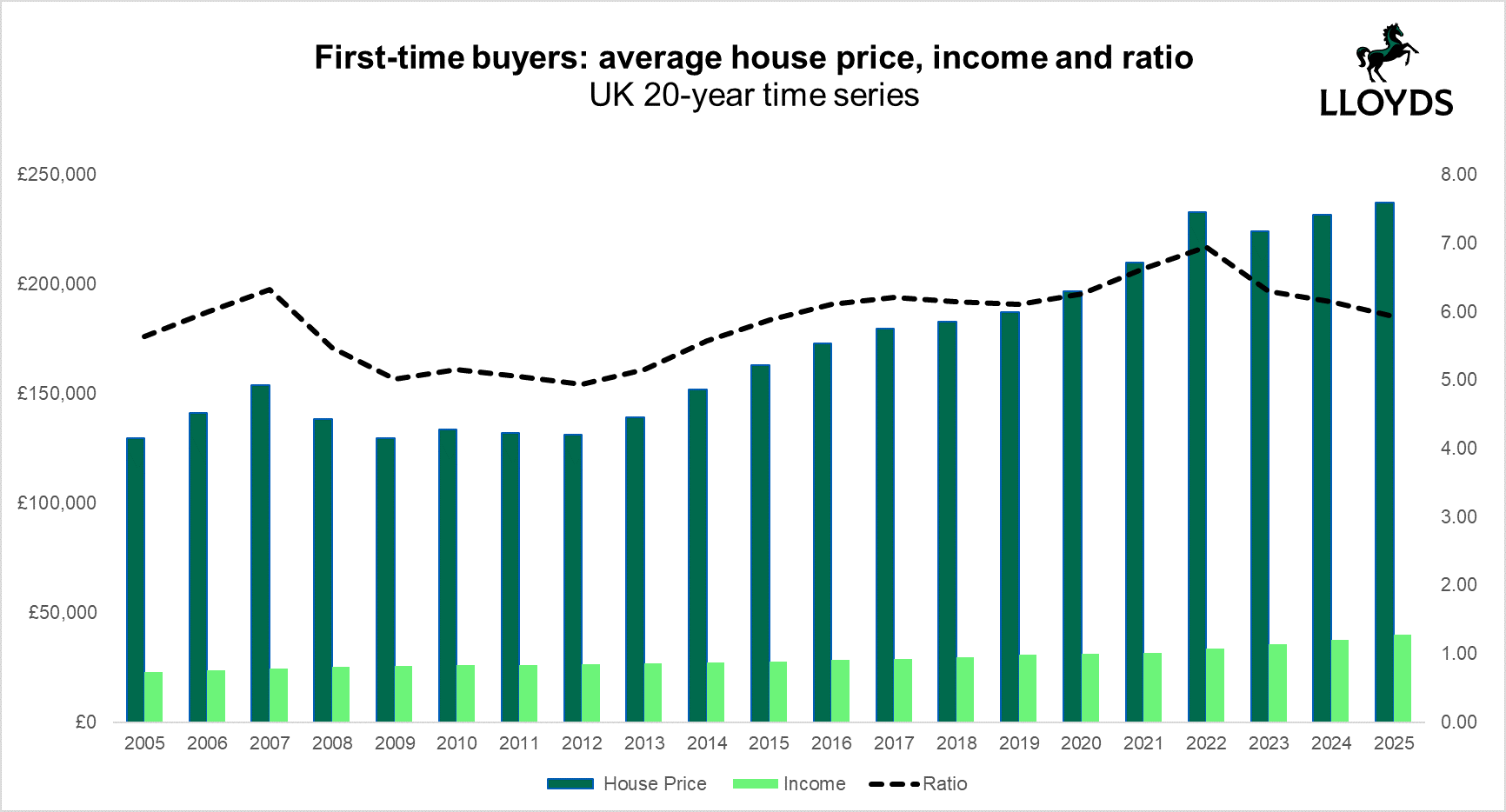
- Typical first-time buyer home now costs 5.9 times average earnings – the lowest ratio since 2015
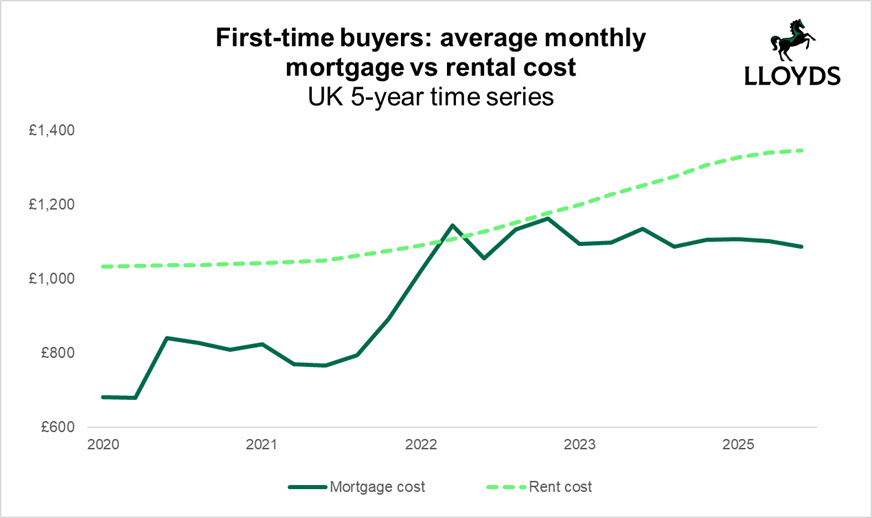
- Average monthly mortgage payment is now £1,087 – around £259 less than renting
- Inverclyde in Scotland is the most affordable location in Britain, Kensington and Chelsea in London the least affordable
- Amanda Bryden, Head of Mortgages, Lloyds: “Lower mortgage rates, rising wages and slower house price growth mean affordability is steadily improving… it’s now better than it’s been for several years.”
A combination of lower interest rates, higher incomes and limited property price growth has improved first-time buyer affordability over the last year, according to new research from Lloyds, part of the UK’s biggest mortgage lender.
At a national level, the typical first-time buyer property price is now 5.9 times average earnings, down from 6.2 last year. This is based on a typical first property costing £237,518, up 2.4% over the last year, while average incomes are up by 6.2% to £40,021.
The last time the property price to income ratio for first-time buyers sat below 6.0 was almost 10 years ago, at the end of 2015 (also 5.9).
Typical monthly mortgage costs have risen by just 0.1% for first-time buyers over the last year to £1,087. This is a result of lower interest rates offsetting the modest increase in property prices.
Calculations are based on typical first-time buyer property prices and the average interest rate for a five-year fixed deal – with a 30-year term and 10% deposit – which has fallen from 4.7% to 4.5% over the last year.
As a proportion of income, average monthly mortgage costs have fallen from 34.6% to 32.6%. That’s the lowest the figure has been since the middle of 2022 (32.4%), prior to the rapid increase in interest rates which occurred later that year.
Amanda Bryden, Head of Mortgages at Lloyds, said:
“Buying your first home is still a big challenge, but things are moving in the right direction. Lower mortgage rates, stronger wages and slower house price growth mean it’s becoming a little easier to get on the ladder – the best it’s been for several years.
“Big national numbers often make the headlines, but the reality is that the housing market can look very different from one town to the next. If you’re searching for your first home, being flexible on location can really help – sometimes moving just a few miles from your preferred area can unlock much better value.”
Rental costs continue to rise
UK rental costs have increased sharply over the last year, rising by 5.5% to a monthly average of £1,346. However, due to strong wage growth, rental payments as a percentage of income have remained stable at around 40%.
Renting is, on average, £259 per month more expensive than typical mortgage costs for first-time buyers, a difference that’s increased by over a third (36%) over the last year.
These figures emphasise that for those who can overcome the challenge of raising a deposit, owning a home can often be more affordable than renting.
First-time buyers doubling-up
The borrowing power of many first-time buyers is often boosted by purchasing with a partner, family member or friend. A significant majority (62%) are now joint applicants and able to call on more than one salary.
According to UK Finance, the average household income for a first-time buyer mortgage application last year stood at just over £65,000* which puts the equivalent property price to household income ratio at around 3.7, and the mortgage cost as a percentage of joint income at closer to 20%.
Regional comparison shows North/South divide
As the UK’s property price to earnings ratio has eased at a national level – making homes more affordable on average – it’s a similar story for first-time buyers in almost all the individual nations and regions of the UK.
In England, Greater London (9.3), the South East (7.3), Eastern England (7.0) and the South West (6.2) saw the biggest improvement in the property price to income ratio for first-time buyers over the last year, falling by 0.4 in each case. This was driven by modest property price inflation coupled with stronger income growth.
It should be noted that these four regions remain the most expensive in the UK to buy a property.
Conversely, the North East of England is the most affordable region for first-time buyers, with a property price to earnings ratio of 3.9. This is up slightly from 3.8 last year, as property prices in the North East rose by around 10% for first-time buyers, outpacing a 7% increase in average income for the area (the strongest of anywhere in the UK).
Mortgage costs as a percentage of income have remained static in the North East, at 22%. For context, this compares with 51% in Greater London.
Scotland is the next most affordable area for those aiming to step onto the ladder, with a property price to income ratio of 4.0, unchanged from last year. In Northern Ireland the ratio stands at 5.1 which is up 0.2 from last year. And in Wales it’s 5.3, down 0.1 from last year.
Inverclyde to Chelsea: where homes are most and least affordable
Across the housing market (including existing homeowners as well as first-time buyers), the UK property price to earnings ratio has fallen from 7.8 to 7.5 over the last year. This is based on a typical property costing £298,521, up 1.9% over the last year, while average incomes are up by 6.2% to £40,021.
Scotland accounts for many of the most affordable local areas in Britain. Inverclyde on the west coast tops the list with a property price to earnings ratio of 3.4. It’s followed by Kingston upon Hull in Yorkshire and the Humber, with a ratio of 3.5.
Kensington and Chelsea is the least affordable local area, with a property price to earnings ratio of 17.7. Next comes Elmsbridge in the South East at 16.6.
The Cotswolds saw the biggest improvement in affordability over the last year, with the property price to earnings ratio falling from 12.0 in 2024 to 9.6 this year, driven by a fall in the value of the average home.
The biggest deterioration in affordability was recorded in Staffordshire Moorlands in the West Midlands, with the ratio there increasing from 5.7 to 6.3 as a result of rising property prices.
|
Most and least affordable local areas by region or nation |
|||
|
Region |
Local area |
Property price |
Price to income ratio |
|
East Midlands |
Mansfield |
£166,604 |
4.6 |
|
Rutland and Melton |
£322,458 |
8.8 |
|
|
Eastern England |
Boston and South Holland |
£188,437 |
4.8 |
|
St Albans |
£544,099 |
13.7 |
|
|
Greater London |
Barking and Dagenham |
£313,270 |
6.2 |
|
Kensington and Chelsea |
£888,085 |
17.7 |
|
|
North East |
South Tyneside |
£134,671 |
3.8 |
|
Northumberland |
£210,960 |
5.9 |
|
|
North West |
Blackpool |
£138,206 |
3.6 |
|
Trafford |
£354,819 |
9.3 |
|
|
Scotland |
Inverclyde |
£136,599 |
3.4 |
|
East Renfrewshire |
£289,277 |
7.1 |
|
|
South East |
Portsmouth |
£212,331 |
5.1 |
|
Elmbridge |
£688,483 |
16.6 |
|
|
South West |
Plymouth |
£197,922 |
5.1 |
|
Cotswolds |
£368,300 |
9.6 |
|
|
Wales |
Neath Port Talbot |
£148,527 |
4.0 |
|
Monmouthshire |
£309,357 |
8.3 |
|
|
West Midlands |
Stoke-On-Trent |
£153,573 |
4.0 |
|
Stratford-on-Avon |
£339,382 |
8.9 |
|
|
Yorkshire & the Humber |
Kingston upon Hull |
£128,366 |
3.5 |
|
North Yorkshire |
£277,825 |
7.5 |
|
Source: Lloyds Banking Group, ONS
Amanda continues:
“Buying a home is one of the biggest financial decisions most of us will ever make. It’s not just about saving money compared to renting – owning a property means building equity and creating a more secure financial future.
“If saving for a deposit feels daunting, start by speaking to a mortgage expert. They can help you work out what’s affordable and guide you through the options, including low-deposit mortgages that let you buy with as little as 5% down.”
Don’t know where to start? Amanda’s top tips:
1. Speak to an expert
Before you dive in, talk to a mortgage expert to get a clear picture of what’s affordable for you. They’ll walk you through everything from deposits to legal fees, and help you understand your options. With Lloyds, you can book a video appointment at a time that suits you.
2. Make your savings work harder
Set up a direct debit into a dedicated savings account to build your deposit steadily. And don’t forget to check out government schemes like the Lifetime ISA – it gives you a 25% bonus on your savings (up to £1,000 a year), helping you reach your goal faster.
3. Explore low-deposit options
You don’t always need a huge deposit to get started. Many lenders, including Lloyds, offer mortgages with just a 5% deposit – making home ownership more achievable. Use a mortgage calculator to see how much you could borrow and what your monthly payments might look like.
Data tables
|
10 most affordable local areas in Britain (all buyers) – Q3 2025 |
|||
|
Local area |
Region |
Property price |
Price to income ratio |
|
Inverclyde |
Scotland |
£136,599 |
3.4 |
|
Kingston upon Hull |
Yorkshire and the Humber |
£128,366 |
3.5 |
|
West Dunbartonshire |
Scotland |
£147,207 |
3.6 |
|
Blackpool |
North West |
£138,206 |
3.6 |
|
Dundee |
Scotland |
£149,575 |
3.7 |
|
Aberdeen |
Scotland |
£151,161 |
3.7 |
|
South Tyneside |
North East |
£134,671 |
3.8 |
|
East Ayrshire |
Scotland |
£154,405 |
3.8 |
|
Angus |
Scotland |
£155,671 |
3.8 |
|
Dumfries and Galloway |
Scotland |
£156,389 |
3.8 |
Source: Lloyds Banking Group, ONS
|
10 least affordable local areas in Britain (all buyers) – Q3 2025 |
|||
|
Local area |
Region |
Property price |
Price to income ratio |
|
Kensington / Chelsea |
Greater London |
£888,085 |
17.7 |
|
Elmbridge |
South East |
£688,483 |
16.6 |
|
Westminster / The City |
Greater London |
£715,678 |
14.3 |
|
Waverley |
South East |
£573,407 |
13.9 |
|
St Albans |
Eastern England |
£544,099 |
13.7 |
|
Hammersmith / Fulham |
Greater London |
£679,258 |
13.5 |
|
Mole Valley |
South East |
£560,199 |
13.5 |
|
Windsor / Maidenhead |
South East |
£545,682 |
13.2 |
|
Richmond upon Thames |
Greater London |
£653,986 |
13.0 |
|
Sevenoaks |
South East |
£534,918 |
12.9 |
Source: Lloyds Banking Group, ONS
|
Regional breakdown: First-time buyer affordability – Q3 2025 |
||||
|
Income |
Price to income ratio |
Monthly mortgage |
Mortgage % income |
Monthly rent |
|
£39,603 |
7.0 |
£1,260 |
38.2% |
£1,242 |
|
£36,544 |
5.5 |
£922 |
30.3% |
£888 |
|
£50,152 |
9.3 |
£2,141 |
51.2% |
£2,252 |
|
£35,902 |
3.9 |
£874 |
27.9% |
£856 |
|
£38,121 |
5.2 |
£646 |
21.6% |
£741 |
|
£37,618 |
5.1 |
£902 |
28.4% |
£914 |
|
£40,645 |
4.0 |
£737 |
21.8% |
£1,001 |
|
£41,396 |
7.3 |
£1,392 |
40.3% |
£1,382 |
|
£38,548 |
6.2 |
£1,102 |
34.3% |
£1,188 |
|
£37,095 |
5.3 |
£905 |
29.3% |
£809 |
|
£38,270 |
5.6 |
£976 |
30.6% |
£934 |
|
£36,930 |
4.7 |
£792 |
25.7% |
£824 |
|
£40,021 |
5.9 |
£1,087 |
32.6% |
£1,346 |
Source: Lloyds Banking Group, ONS


